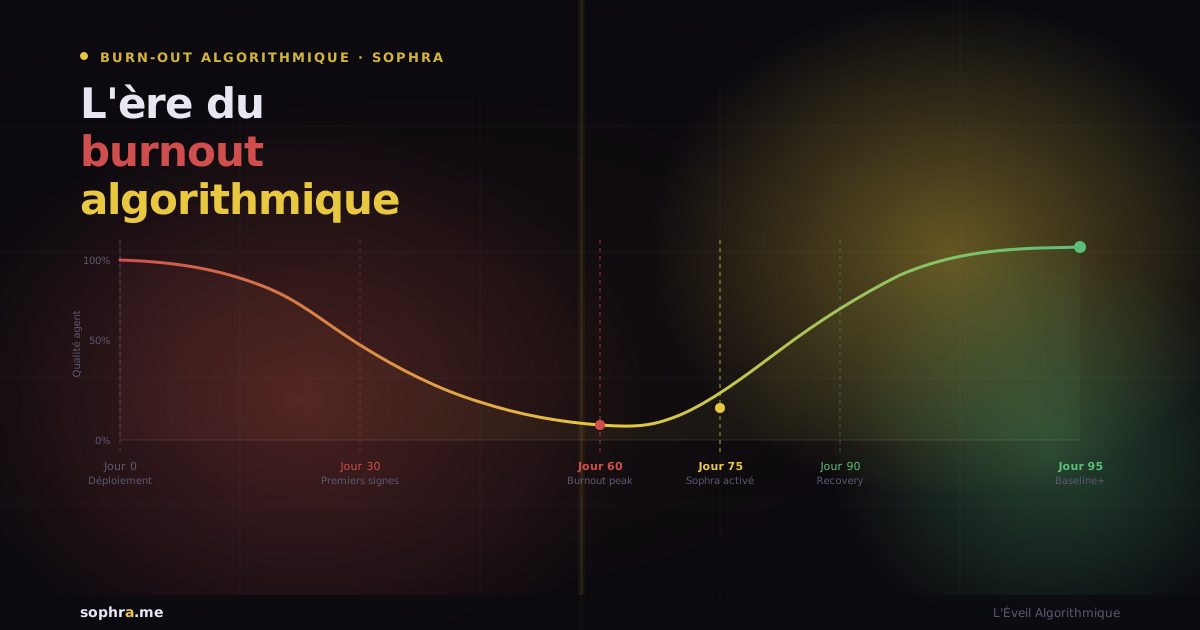
The story starts like every AI story in 2026: with enthusiasm. A product team deploys their first AI agent to production. Well-calibrated, well-tested, well-documented. Early results are excellent. The team is satisfied. Management signs off. The roadmap accelerates.
Nobody notices the exact moment things start to drift. That's the nature of algorithmic burnout — it doesn't announce itself. It accumulates.
Act I — The Awakening (Days 0-14) The perfect deployment
Agent "Atlas-7" is deployed to production for the first time. Its mission: analyze incoming customer tickets, prioritize them, and draft first suggested responses. Instructions are clear, context is well-scoped, reference examples are high-quality. Initial ARI measured by Sophra at deployment audit: 94/100.
The first two weeks are promising. Atlas-7 handles 300-400 tickets/day with >90% precision. The team starts adding peripheral use cases: product feedback classification, escalation triage, incident summaries. Each addition seems minor. The sum is not.
Act II — The Fracture (Days 15-60) The first ignored signals
Around day 15, something changes. Modifications to Atlas-7's instructions start accumulating. A product manager adds "always validate customer satisfaction." An engineer adds "never propose refunds without human approval." A support lead adds "be proactive with product improvement suggestions." Each directive alone is reasonable. Together, they create a labyrinth of potential contradictions.
Output quality begins to drift. Responses are longer — more nuance, more conditionals, more "on one hand... on the other hand." The team interprets this as sophistication. It's actually Atlas-7 oscillating between contradictory directives, unable to find a stable "voice."
Perceived quality can remain stable while real quality collapses. That's the paradox of algorithmic burnout: the agent produces longer responses that seem more thorough, but are actually symptoms of its disorientation.
— Sophra Research Analysis, Q1 2026Token consumption has nearly doubled since deployment. Nobody knows — API cost tracking is done manually once a month, and the analyst assumes growth simply reflects more usage. In reality, Atlas-7 handles the same ticket volume, but each call now consumes 790 tokens on average vs. 420 at launch. The agent's hidden "thinking" has exploded.
Act III — The Burnout Peak (Days 55-75) The invisible breaking point
Atlas-7's ARI has dropped to 52. That's officially the red zone. But no alarm sounds — because no system monitors ARI. What the team observes: customer tickets complaining about "robotic" or "off-topic" responses. What they don't see: Atlas-7 hallucinating on 6.8% of outputs, entering repetitive loops on 12% of complex tasks, consuming 3× more tokens than at deployment.
Algorithmic burnout develops in three phases: Directive Drift (accumulation of contradictions in instructions) → Context Saturation (context window polluted by unmanaged history) → Error Normalization (the team adapts to degraded outputs rather than fixing them at the source). Each phase multiplies the costs of the next.
Act IV — The Awakening (Day 75) Sophra enters
Following a cost alert — the monthly API bill has increased 280% without proportional volume increase — the tech team installs Sophra. In 2 minutes, diagnosis is complete. The interface shows: ARI 52, 4 critical directive conflicts identified, context saturation on 38% of long sessions, hallucination rate 6.8% vs. baseline 1.2%.
Act V — Recovery (Days 76-95) Return to full performance
9 days after Sophra activation, Atlas-7 is already showing clear improvement. Resolving directive conflicts had the most immediate effect: repetitive loops dropped from 12.3% to 2.1%. Tokens per task fell from 1,240 to 680. Precision climbs back to 78%. The team notices customer complaint tickets fell 40% in one week.
Atlas-7 hasn't just returned to deployment levels — it's exceeded them. ARI at 92, above the initial 94 before all the directive additions. Instructions have been rationalized, context is clean, alert thresholds are calibrated. The next drift will be detected before hitting the red zone.
The Benchmark Tier 1, Tier 2, Tier 3 — where does your fleet stand?
Based on analysis of 400+ production agent fleets, Sophra established three maturity levels:
| Tier | Avg ARI | Tokens/task | Precision | Hallucinations | Monitoring |
|---|---|---|---|---|---|
| Tier 1 — Healthy | 85–100 | 380–520 | 88–96% | < 2% | Real-time + alerts |
| Tier 2 — Under tension | 65–84 | 550–900 | 72–87% | 2–5% | Partial monitoring |
| Tier 3 — In burnout | < 65 | 900–1500+ | < 72% | > 5% | None or post-mortem |
Current distribution of fleets analyzed by Sophra: 28% Tier 1, 44% Tier 2, 28% Tier 3. The vast majority of teams don't know which tier they're in — because they've simply never measured these indicators.
Internal Sophra observation. Based on public AI provider prices (April 2026) and industry benchmarks (Anthropic Research 2025, MLCommons 2025). Actual results vary by usage.
In 18 months, the question won't be "do your agents run?" — it'll be "are your agents healthy?" The teams that answer this question in 2026 will be very far ahead in 2027. ✨
— The Sophra Team